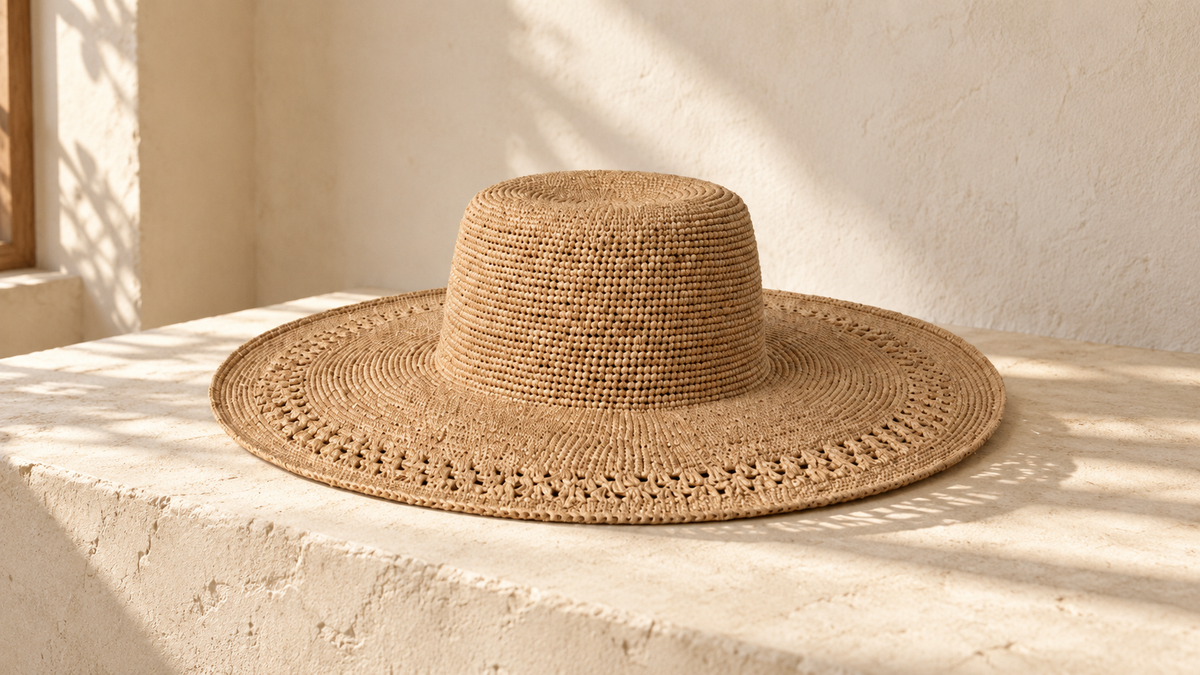

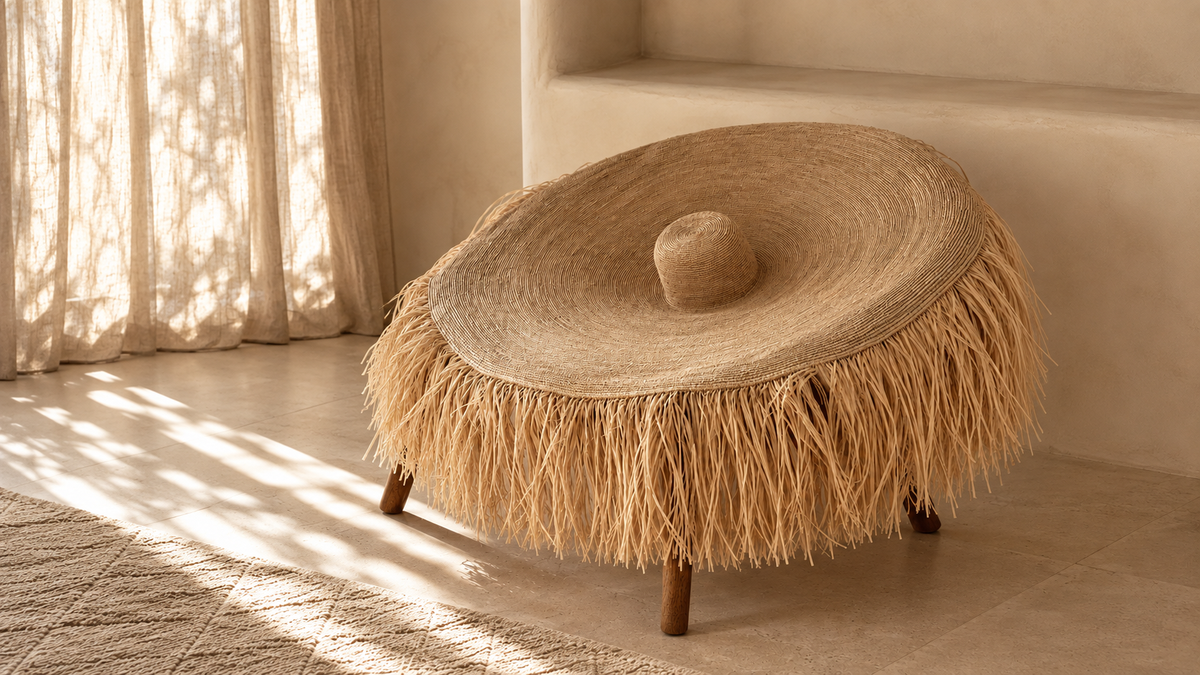
A small crown at the centre, a broad disc of crochet and long, loose fringing: VELATRA retains the instantly recognisable silhouette of a hat. Yet at 120 cm in diameter, this one-of-a-kind raffia piece moves to a different scale and becomes a sculptural object. Entirely crocheted by hand in Madagascar, it belongs to Marevaka Éditions and invites us to see a familiar form anew.
A hat silhouette on a sculptural scale
The eye first rests on the centre. The crown forms a compact raised volume, around which rows of crochet spread in circles. The brim extends widely before continuing into the fringe. This succession of volumes gives VELATRA its character: a defined centre, a generous surface and a freer edge.
From a distance, the strength of the circle is apparent. Up close, stitches, strands and the fibre’s subtle shades emerge. The piece reveals itself at several distances. The hat remains present, down to the small crown that recalls its origin, while its proportions suggest another way of displaying it.
Raffia crochet, worked by hand in Madagascar
VELATRA is crocheted entirely by hand in Madagascar. This craft shapes both the crown and the large disc around it. Concentric lines make the work visible: they guide the eye from centre to edge and give the surface its rhythm.
The density of the crochet gives the material structure. At the perimeter, long fringing lets the strands fall freely. The transition alone creates relief. To understand how this technique develops a circular form, our journal article on crocheting raffia in the round explains the principle.
A natural material revealed by light
Natural raffia from Madagascar has variations in shade and texture that contribute to VELATRA’s presence. In the crocheted areas, the strands form a close surface with an even pattern. In the fringe, their differences become more visible.
Side lighting highlights the rows, reveals shadows between the fibres and separates the fringe from its background. It is a simple way to read the piece: observing what light reveals in the material. Our article from palm to raffia fibre takes this discovery further.
Where does VELATRA belong in an interior?
Its 120 cm diameter deserves a setting where the full circle can unfold. A plain background, pale textile or understated furniture lets its silhouette and the pattern of the fringe emerge. Only a few elements are needed around it: open space is part of the presentation.
Styled on a bed or placed on a suitable support, VELATRA can be appreciated from above and at an angle. Before bringing it home, take time to measure the intended space and plan support that preserves its form. The fringe should hang freely, away from passing feet.
Can VELATRA be displayed on a wall?
Displayed on a wall, the piece can be read as a composition. Hanging arrangements should be discussed with the House before installation. To explore this possibility in your interior, write to us about VELATRA.
Can VELATRA be worn?
VELATRA can be styled on the body, returning to its origins as a hat. Its 120 cm scale makes it first and foremost a sculptural piece. This presentation continues the dialogue between body, clothing and object.
A single piece for Marevaka
Only one VELATRA has been made. This edition brings form, material and handwork together in a singular piece. It gives raffia a sculptural expression within Marevaka’s creations for the home.
Preserving the form and fringe
Handle VELATRA by supporting its form, never lifting it by the fringe. Keep it dry, away from moisture and prolonged sunlight. Dust gently with a soft, dry cloth. The piece must not be washed or immersed.
Dedicated packaging is provided to protect its volume. Delivery arrangements are confirmed with you before dispatch, so that its arrival at your address can be prepared.