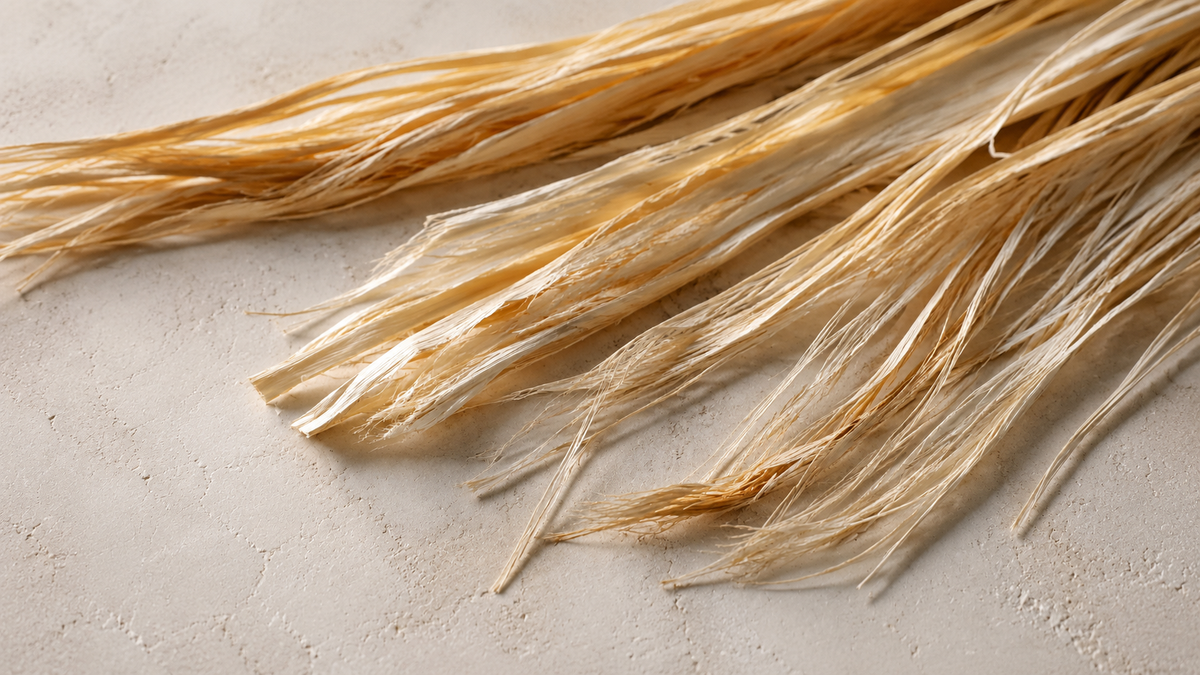

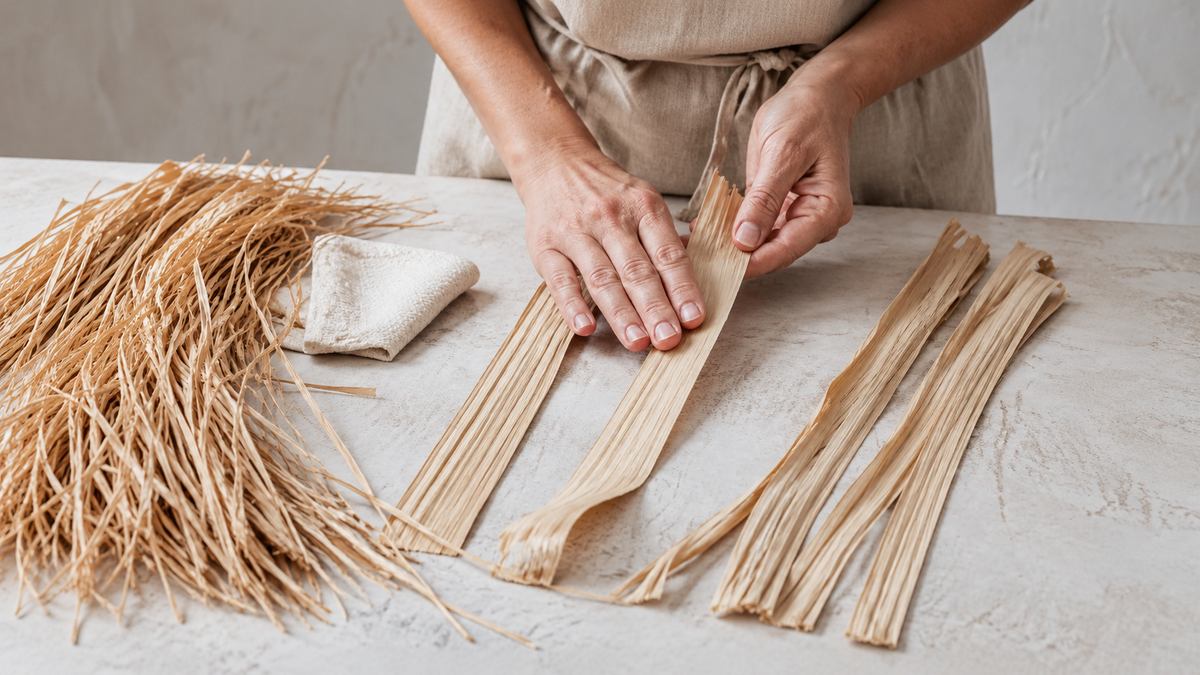
Before the first stitch, the hand is already listening to the material. Dry raffia must be sorted, aligned and gently softened: too dry, it creases or breaks; too wet, it stretches and becomes difficult to control. Preparation is the first expression of the craft.
Aligning the strips before beginning
The sorted strips are aligned so their ends remain easy to grasp. Arranged this way, they do not tangle, and the hand can quickly find the width it needs. Weak or stained areas are removed before work begins.
This preparation time, invisible in the finished piece, reduces interruptions. The artisan can keep her rhythm and focus on the form.
Adjusting width while preserving the fibre
When a strip is too wide, it can be split lengthways. The movement follows the fibrils to create two even ribbons. A rough split produces fraying edges or sections that are too thin.
The choice depends on the intended stitch. An openwork pattern can use a slightly wider strip. Repeated double crochet through a crown may call for a more consistent width to avoid excessive thickness.
Adding just enough moisture
Softening happens locally and gradually. The fibre may be handled with very lightly dampened fingers or placed briefly in conditions that restore its flexibility. A little moisture for a short time is enough; immersion or damp storage weakens the fibre.
The amount varies with the weather and the batch. In humid air, ambient moisture is usually sufficient. In a very dry room, more regular attention helps prevent breakage.
Volume begins before the first stitch
A properly softened fibre follows the hook without losing its body. It settles into the stitch and retains the curve given by the row. Prepared in this way, the fibre gradually follows the volume built through successive rows.
Preparation also improves stitch consistency and the piece’s structure. It affects density, dimensions and final stability. The construction of volume begins before the first loop.