
Raffia bends, resists tension, absorbs a little moisture and remembers a curve. These responses come from the combination of cellulose, hemicellulose, lignin and smaller amounts of other compounds. Their proportions vary with species, maturity and analytical method. This variation reminds us that a plant fibre comes from a living organism and has a composition of its own.
Cellulose gives the fibre strength
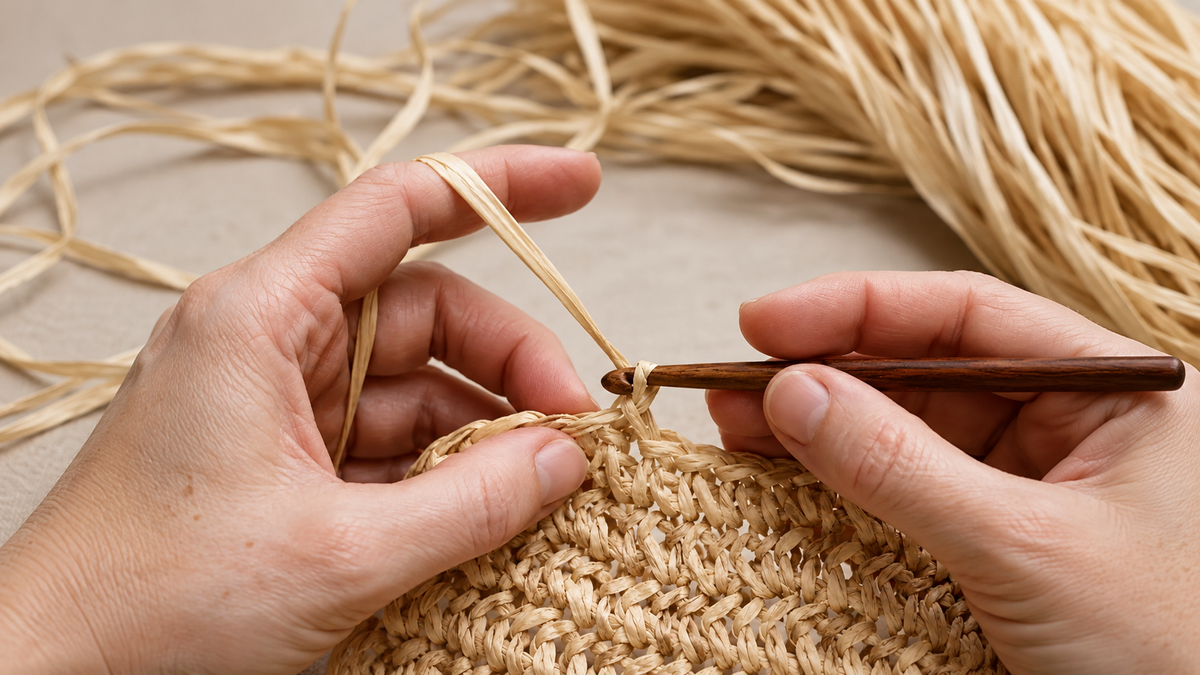
Cellulose consists of long molecular chains. Within plant cell walls, they gather into tiny filaments whose orientation strengthens the fibre when it is pulled lengthways. In a strip of raffia, this lengthwise alignment helps the material withstand the tension applied during knotting or crochet.
That strength comes with an ability to bend. A very thin strip can curve because it has little thickness and its layers can slide slightly against one another. Craft makes use of a structure that is strong along its axis yet still able to be shaped.
Hemicellulose retains some moisture
Hemicellulose is the name for several polysaccharides, complex sugars associated with cellulose. It helps organise the cell wall and interacts readily with water. This affinity makes plant fibres hygroscopic, meaning they can absorb some of the moisture in the air. Humidity changes raffia’s behaviour: it becomes more supple in a damp atmosphere and firmer in a dry, well-ventilated room.
In everyday use, this calls for simple care. Avoid soaking, let a slightly damp piece dry naturally and store it away from persistent moisture. These precautions respect the material instead of expecting it to behave like a synthetic fibre.
Lignin reinforces the fibre
Lignin is another major component of plant tissues. It strengthens cell walls and contributes rigidity. It influences the fibre’s body, colour and response to heat. Published analyses report different proportions of cellulose, hemicellulose and lignin depending on the species and type of sample.
A recent study of Raphia vinifera fabric measured 52% cellulose, 14% hemicellulose and 25% lignin. These figures describe the sample studied, not all raffia. They nevertheless offer a useful indication: the fibre combines cellulose and lignin, among other constituents, in naturally varying proportions.
What the fingers feel
Raffia’s dry touch, its gentle rustle when handled and its ability to retain a curve all come from this composite structure. Cellulose resists tension, hemicellulose helps regulate exchanges with water and lignin consolidates the whole. Waxes, pigments and other minor compounds further affect the surface.
Crochet preserves the fibre’s composition while organising its form. By multiplying loops and points of support, it turns a fine strip into a strong surface. The structure of a hat or basket comes both from the material itself and from the geometry patiently built by hand.