
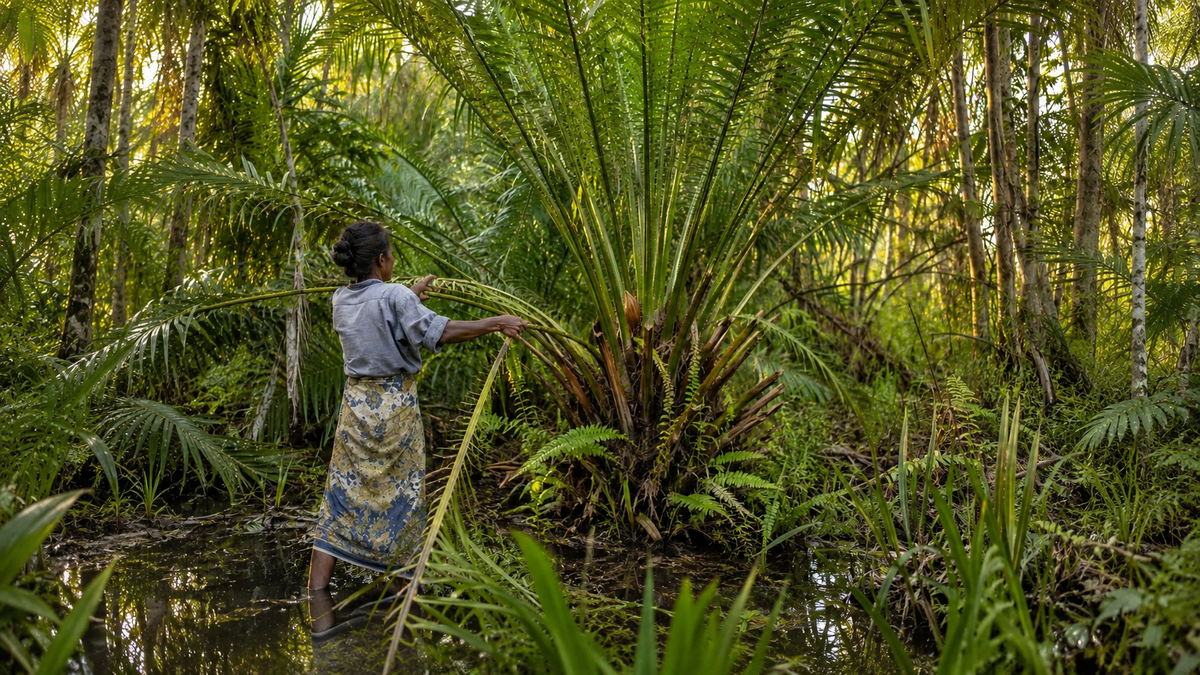
A plant material remains renewable when the plant has enough time to replace its leaves. Harvesting raffia requires more than a skilled hand: it means observing the crown, choosing without stripping it bare and considering all the palms in the surrounding habitat. Fibre quality begins with that restraint.
Leaving enough leaves for the palm to live
Leaves carry out photosynthesis. Removing too many young shoots deprives the palm of some of the leaves it will need to feed itself. A cautious practice leaves enough mature foliage and spreads harvesting across several palms. Choosing a leaf must preserve the growing point and the continuity of the crown.
The number of leaves that can be taken depends on the species, the palm’s age and vigour, and its environment. Age, health, season and local conditions affect what the plant can withstand. Knowledge of the ground is therefore more useful than an abstract rule repeated far from the harvesting site.
Allowing time between harvests
Balanced harvesting returns to an area once the palms have produced new leaves. Rotating harvest areas avoids repeatedly drawing on the most accessible palms. It also allows their response to be observed and harvesting frequency adjusted when growth slows.
That patience is later reflected in fibre quality. A vigorous palm produces better-developed leaflets. Pursuing immediate volume alone eventually weakens the resource and makes the available fibres less consistent.
Looking at the whole palm population and its habitat
The resource renews itself where young shoots, adult palms and palms reaching reproductive age coexist. A landscape made up only of ageing adult palms suggests insufficient renewal, despite an apparent abundance. Natural regeneration and access to water therefore need to be observed.
Other land uses matter too. Drainage, clearing, fire or a change of crop can affect the habitat more severely than the removal of a few leaves. Protecting the material means looking at the environment that enables the palm to live.
Understanding where the fibre comes from
For a House, the right approach is to ask each intermediary precise questions: geographical origin, season, harvesting method, drying process and how supply is organised. Where information is missing, it should be identified as something still to be verified.
MAREVAKA chooses to speak about raffia with this care. The beauty of a piece begins with an accurate understanding of the resource, giving us one more reason to look after it.