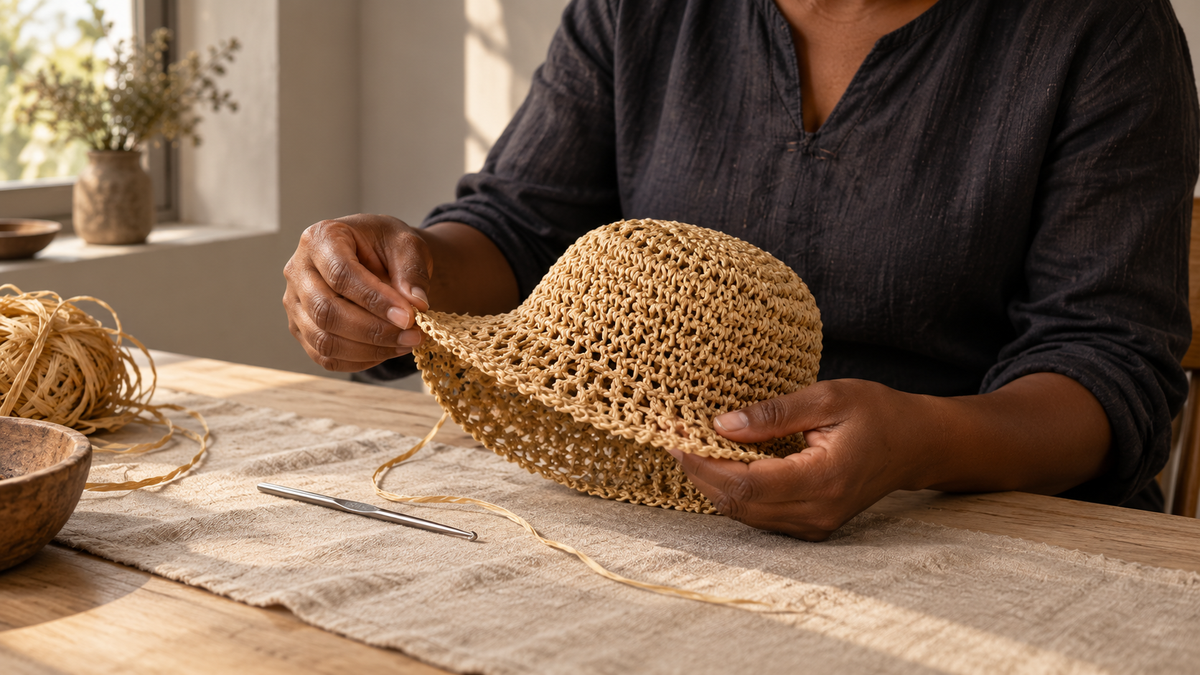

Raffia resists, varies and remains tangible beneath the tool. Crochet suits it for precisely these reasons: a single active loop allows the maker to adjust each stitch, follow a curve and build volume without imposing machine-like uniformity.
Adapting every stitch to the fibre
Crochet forms each stitch through successive loops. The artisan can tighten a fine fibre or allow more room for a wider strip. Adjusting stitch by stitch accommodates some of the material’s natural variation.
Unlike fabric that is made first and then cut, the object is built directly to its final dimensions. The material is placed where the form needs it.
Building volume in the round
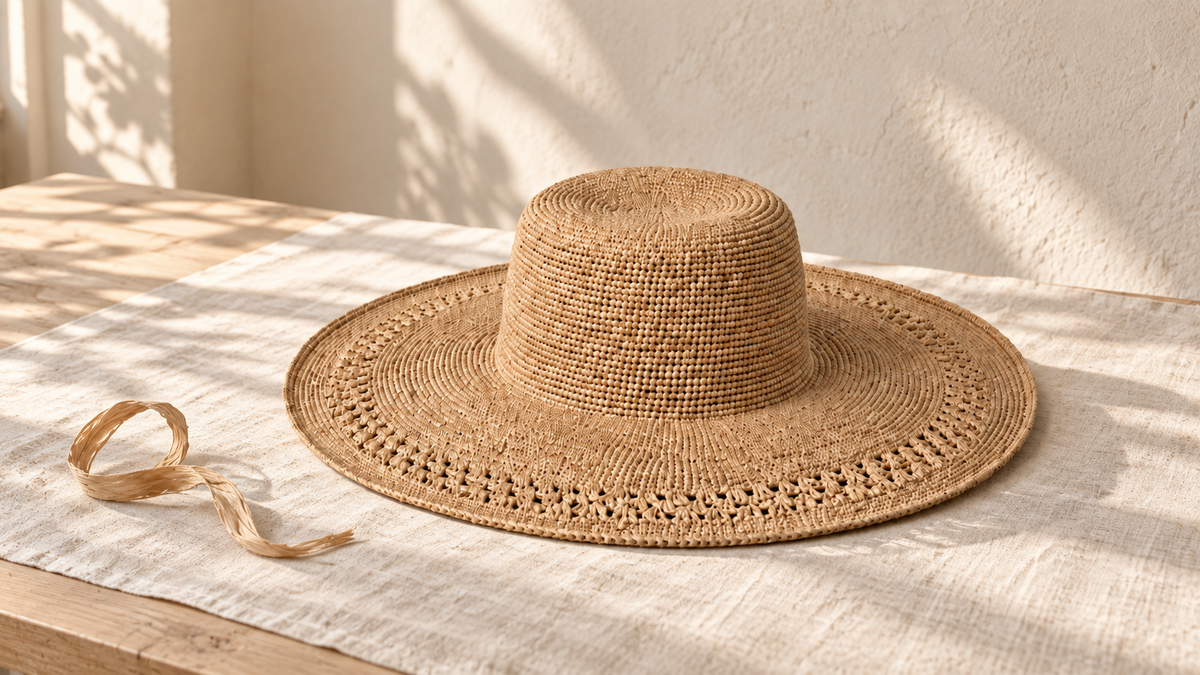
Working in the round creates a crown or brim from a centre. Increases enlarge the surface. Their rhythm determines whether it stays flat, becomes convex or flares.
In a hat, this continuity joins crown and brim within a single construction. Seams are kept to a minimum, and the curve follows the intended design.
Moving from density to openwork
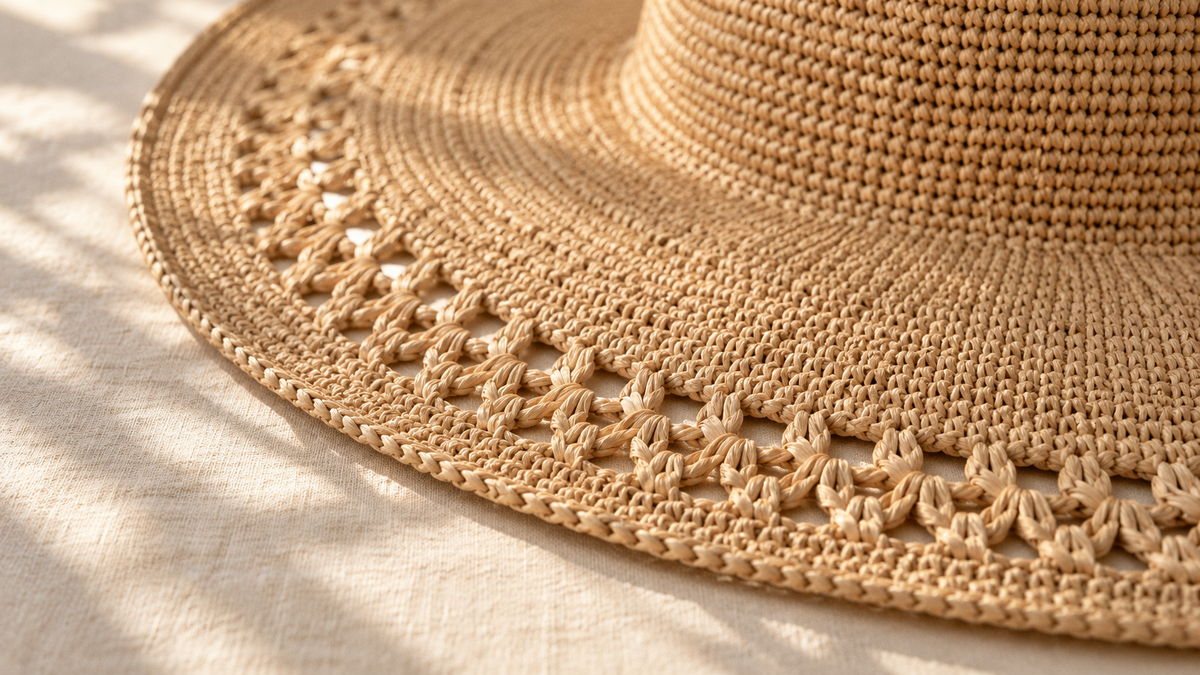
Double crochet gives structure. A treble lengthens the stitch. Chains create open spaces. The same material can become dense, supple or open depending on the stitch chosen.
Light brings out these differences strongly in raffia. Shadows settle into the recesses, making the stitch part of the design.
Preserving raffia’s character
Crochet respects raffia’s texture, variations in width and subtle shades. It uses the material’s body and leaves its relief visible. Excessive tension can strain the fibre and make the movement stiff; too little tension lets the form lose structure.
The right balance lies in this agreement. The technique guides the material without asking it to become something else.