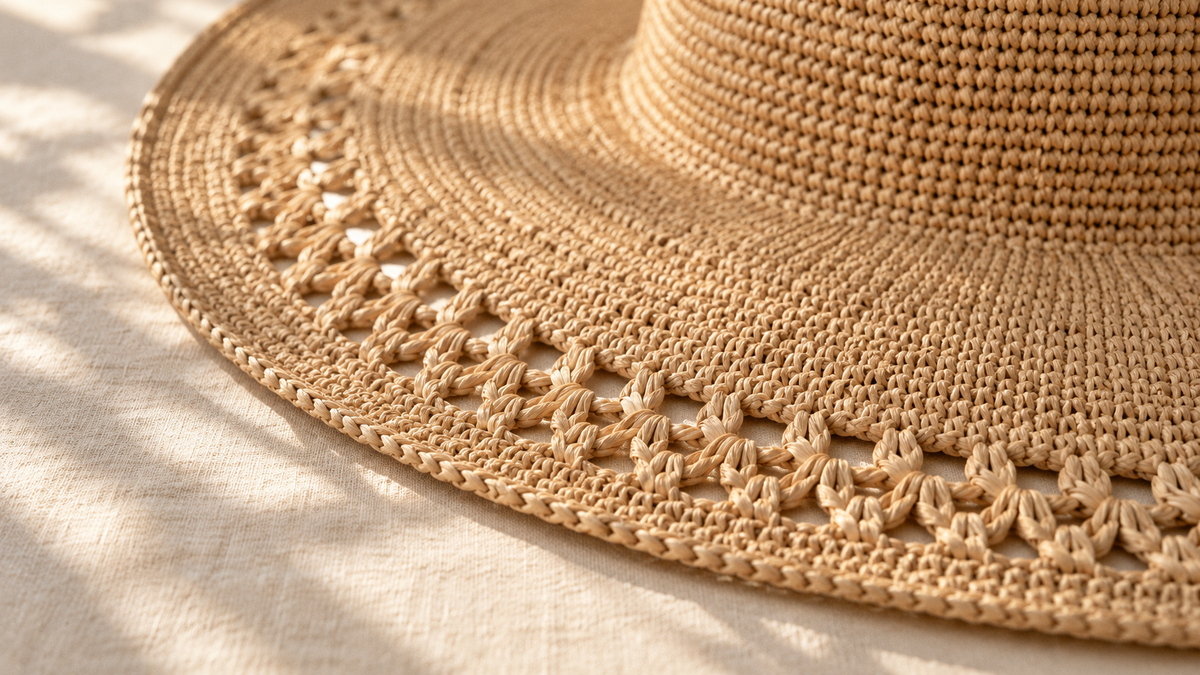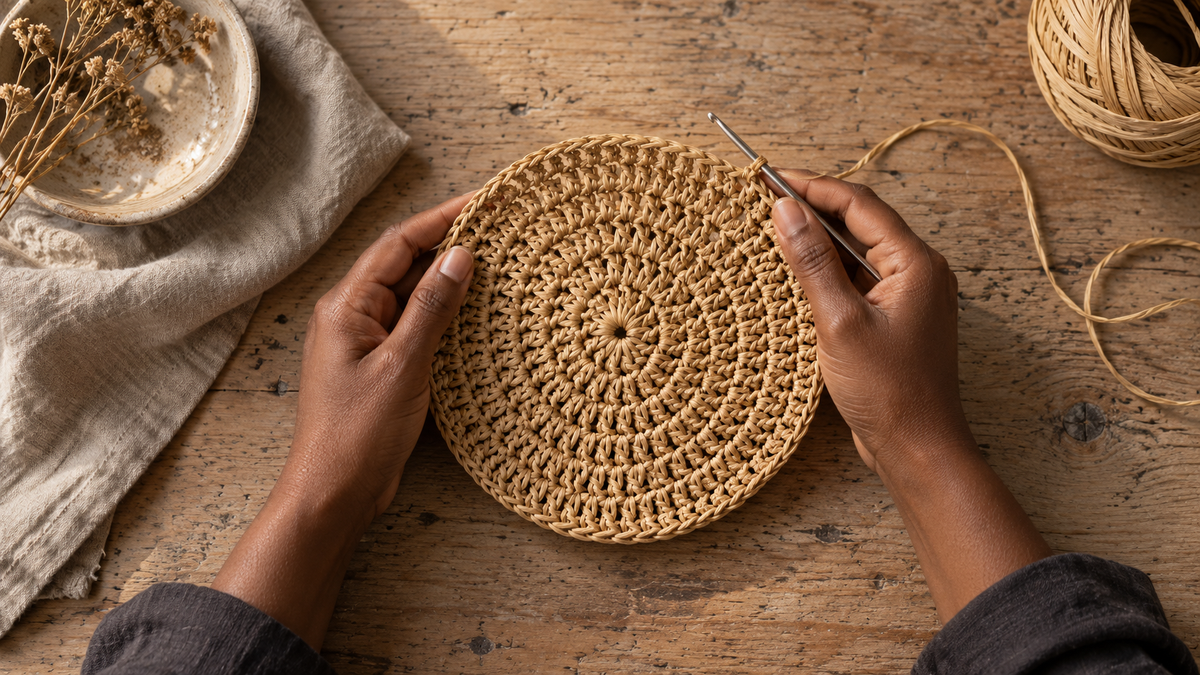


Short and dense, double crochet builds slowly and gives raffia remarkable structure. Row after row, the loops come together to form a surface in which the material almost supports the shape on its own.
A short, strong stitch
Each stitch adds little height. More rows are needed to build volume, but their low profile tightens and stabilises the whole. The loops interlock and distribute forces across many points.
With a plant strip, this density provides structure without adding a framework. It suits crowns, structured brims and areas subject to repeated handling.
Regulating tension
Double crochet worked too tightly makes the process difficult and can distort the volume. Too loose, and it leaves uneven gaps. The hook should enter the next stitch without force, while the loop remains snug enough to support the form.
Raffia varies in width. The artisan subtly adjusts her movement so that the visual density stays consistent from one strip to the next.
Changing texture through the chosen loop
Worked under both loops, double crochet gives a classic, stable structure. Worked into the back loop only, it creates a raised line and more flexibility between rows.
Depending on the loop chosen, the same stitch can mark a transition, follow a curve or emphasise a detail without changing material.
An anchor for openwork patterns
Double crochet can alternate with chain stitches, elongated stitches or stitches inserted in different positions. It then anchors a more open pattern.
Its simplicity is no limitation. In raffia, its repetition creates a restrained texture in which the consistency of the hand becomes the main decoration.