
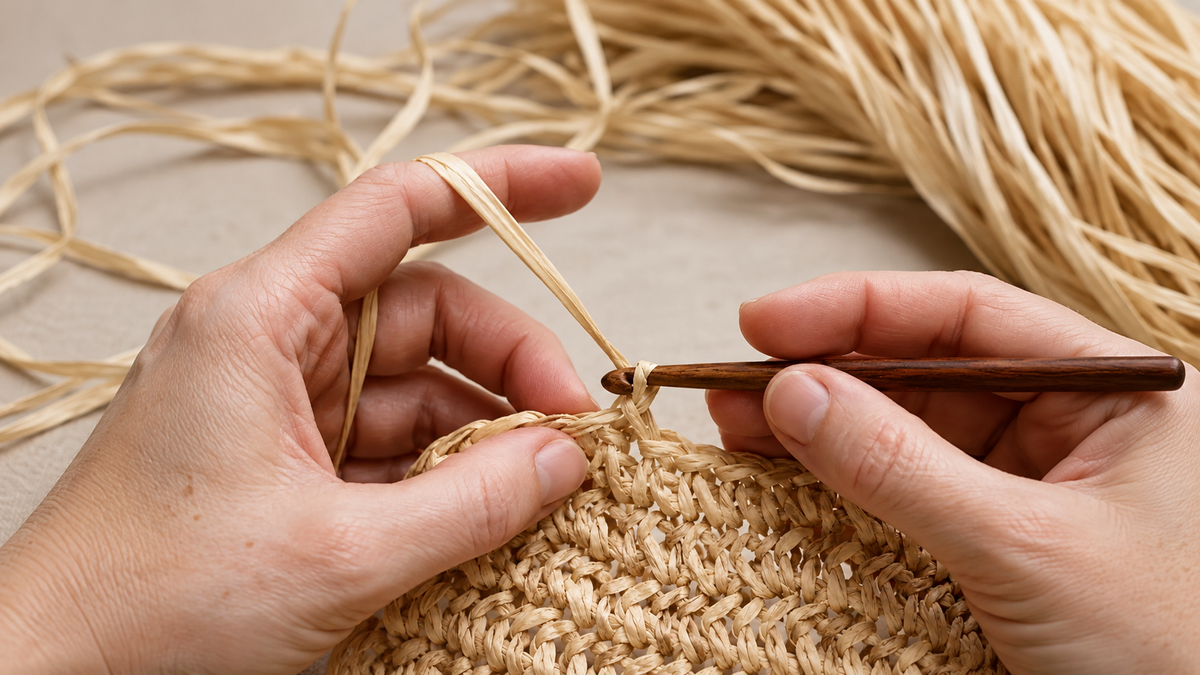
A stitch lives in a tiny gesture that already contains the whole piece. The loop on the hook, the point where the hook enters, the yarn over and the passage of the fibre together determine height, texture and flexibility. Watching them reveals how the hand brings a surface into being.
The loop that stays on the hook
The loop on the hook is the only one that remains open during work. Its size directly affects tension. If it lengthens, the stitches become looser. If it tightens around the tool, the movement becomes strained and the surface contracts.
With raffia, this loop must let the strip pass without crushing it. The hook’s diameter helps keep the space consistent.
Where the hook enters the stitch
The hook may pass under both top loops of a stitch, under the front loop, under the back loop or into a chain space. This choice changes texture and flexibility.
Always working into the same loop can create a horizontal line. Using both loops generally produces a more compact, stable structure.
How the fibre forms a new loop
A yarn over places the fibre around the hook to form a new loop. Double crochet requires little height. For a half treble or treble, the fibre first passes around the hook and is then drawn through successive loops.
Each operation is simple; linking them together demands great consistency. Raffia shows variations more clearly than a highly elastic yarn.
Recognising the top of a stitch
Seen from above, a stitch often forms a small V. Each V shows where to insert the hook on the next row and provides a point for counting stitches. Its orientation can also reveal twisting or uneven tension.
Reading this line helps the artisan spot a missed stitch before the error changes the whole form. Observation constantly accompanies the gesture.