
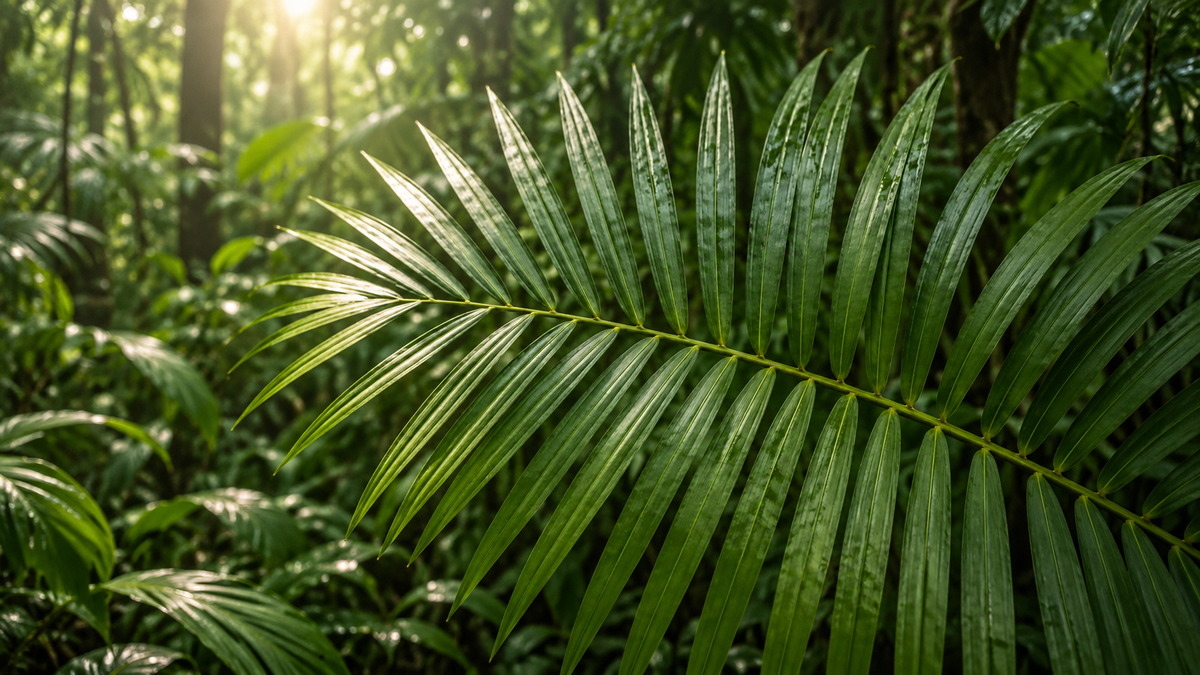
Before it is a fibre, raffia is a leaf of remarkable dimensions. A powerful central axis carries dozens of leaflets; the membrane used in craft lies on the surface of the youngest. In every variation in thickness, every vein and every shade, the finished piece retains something of the plant.
A leaf arranged like a feather
Botanists call these leaves pinnate: their leaflets line up on either side of a central axis, or rachis, like the barbs of a feather. The petiole connects the whole structure to the palm. The axis supports the leaf’s weight and withstands the wind, while the leaflets spread a broad surface towards the light.
The spectacular size of some leaves in the genus Raphia comes from the repetition of many leaflets. Across their considerable length, width, thickness and shade still vary. The surface is divided into narrower units, threaded with fine networks that transport water and nutrients and reinforced by fibrous tissues.
Beneath the surface: tissues that protect and transport
Like any leaf, a raffia leaf has a protective epidermis. Beneath it lie tissues carrying water and the substances the plant needs, together with cells that contribute rigidity. Craft fibre comes from the surface membrane of a young leaflet, skilfully removed to preserve a usable length.
Under a microscope, fibres from several raffia species appear in layers, with tiny elements aligned lengthways. This alignment helps explain how the material behaves: it splits readily along its length while resisting tension applied in the same direction.
Why young leaves are selected
As the plant grows, its tissues become stronger. A very mature leaflet is firmer and harder to peel into long, supple strips. At an earlier stage, its surface layer can be lifted more continuously. The timing of extraction therefore influences the fineness, length and evenness of the raffia obtained.
Seeking this stage does not justify indiscriminate harvesting of young leaves. The plant depends on its foliage to live and grow. The quality of a supply chain also rests on its ability to balance the needs of craft with the palm’s renewal, informed by local knowledge of the palms’ condition.
What the leaf leaves in the object
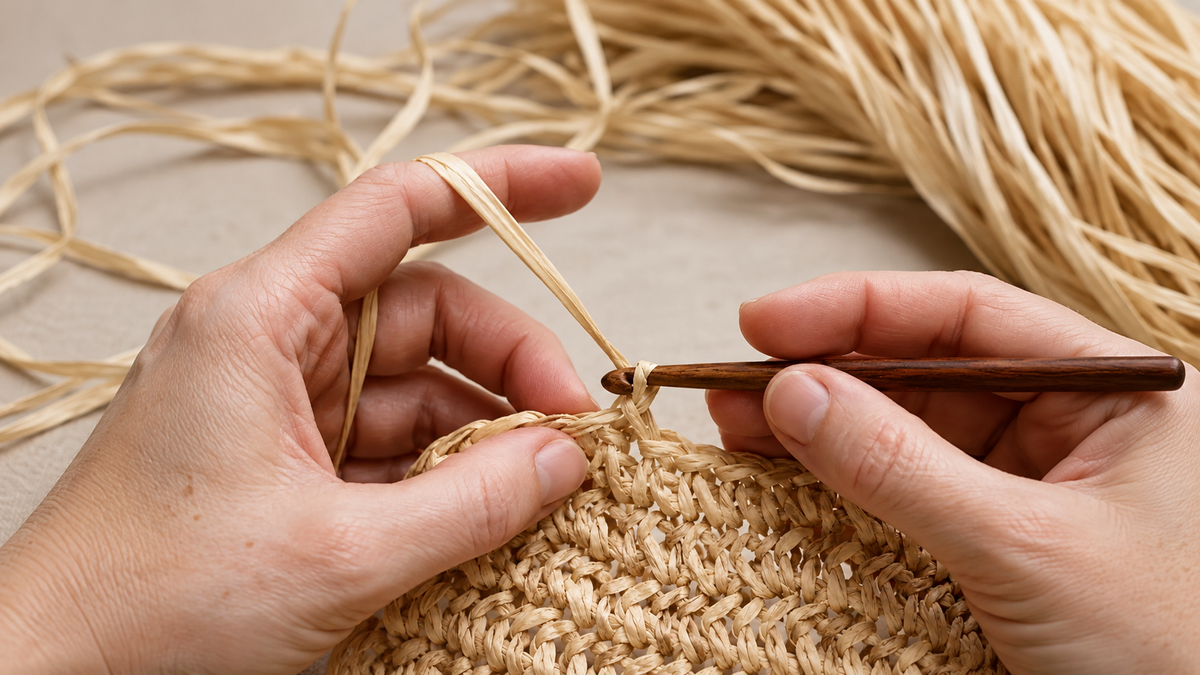
Even after preparation, the fibre carries signs of its origin. A paler vein, a slight difference in thickness or a bend in the strip may show within a stitch. These variations are the marks of a material that has grown with nuances of its own.
Crochet brings these variations into an ordered whole rather than erasing them. Repeated stitches create a coherent surface, while light picks out the smallest differences. The meeting of plant structure and human precision gives raffia its visual depth.